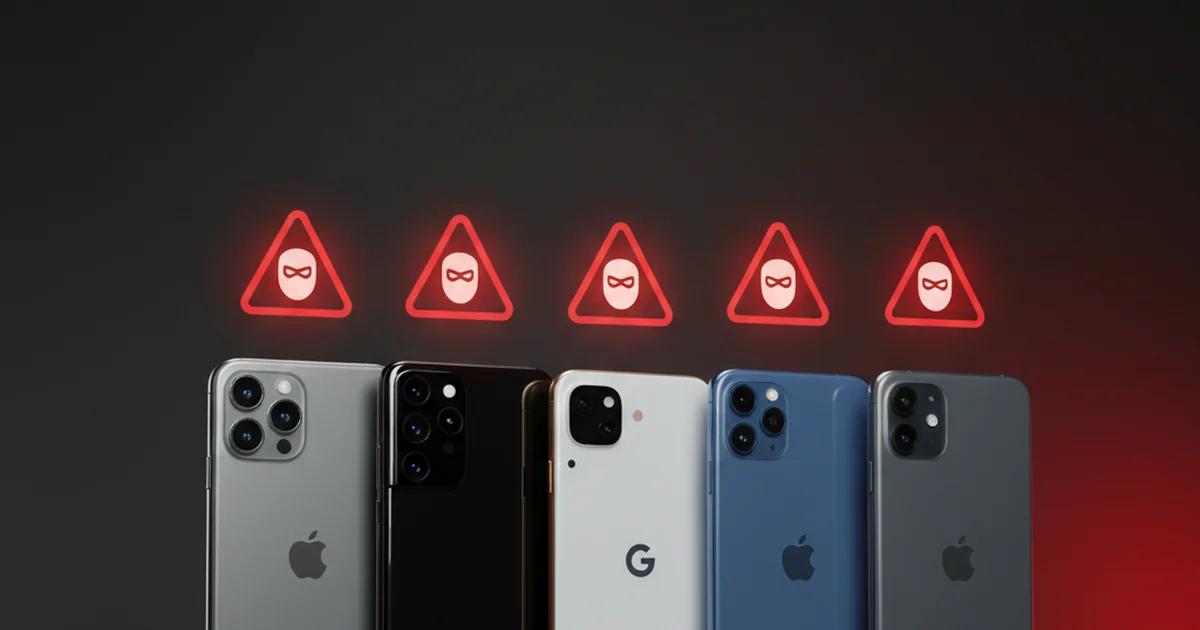

Every 77,000 seconds, a smartphone is stolen somewhere in the world. In the United States alone, over 1.4 million mobile phones were stolen in 2023, according to crisis management reports — and the numbers have only climbed since. Whether you’re in New York, Toronto, or Johannesburg, phone theft is a real, daily risk. But here’s the thing most people don’t know: certain phone models are targeted far more than others.
In this guide, we break down the most stolen phone models in 2026 across the USA, South Africa, and Canada — backed by crime data, police reports, and carrier blacklist statistics. We’ll also show you exactly how to protect your device using IMEI-based tools before and after theft.
Why Trust This Guide: Our data is sourced from CTIA (USA), the ISS Africa policing reports, the Canadian Radio-television and Telecommunications Commission (CRTC), GSMA global device data, and verified crime statistics from law enforcement agencies. We cover IMEI security for a living — and we want you protected.
Table of Contents
- Why Certain Phones Are Targeted More Than Others
- Most Stolen Phone Models in the USA (2026)
- Most Stolen Phones in South Africa (2026)
- Most Stolen Phones in Canada (2026)
- What Happens to Your Phone After It’s Stolen
- How IMEI Blacklisting Protects You
- How to Protect Your Phone Before It Gets Stolen
- Frequently Asked Questions
Why Certain Phones Are Targeted More Than Others
Thieves aren’t random. They’re calculated. The most stolen phones share a few key traits:
- High resale value — flagship iPhones and Samsung Galaxy devices fetch $300–$800+ on grey markets
- High demand in secondary markets — popular models are easier to sell quickly, especially across international borders
- Weak pre-theft protection — devices without activation lock or IMEI registration are easier to repurpose
- Easy to identify — a distinctive design (like iPhone’s notch or camera island) makes spotting a high-value target easy for a thief in seconds
Understanding this helps you make smarter choices — and take the right protective steps with your specific device.
Most Stolen Phone Models in the USA (2026)
The United States is among the top countries globally for smartphone theft. With 85% of US adults owning a smartphone (Pew Research Center, 2023), the pool of targets is enormous. Here are the most targeted models in 2026:
1. Apple iPhone 15 and iPhone 16 Series
iPhones consistently dominate US theft statistics. The iPhone 15 and iPhone 16 (including Pro and Pro Max variants) are the most reported stolen devices in major US cities including New York, Los Angeles, Chicago, and Houston. Their second-hand value — often $500–$900 even on blacklisted grey markets overseas — makes them prime targets.
A 2023 malwarebytes investigation revealed an entire smuggling network moving stolen iPhones from the US to China. A single stolen iPhone led police to a gang that had shipped 40,000 snatched devices internationally (BBC, 2024).
2. Samsung Galaxy S24 and S25 Series
Samsung’s flagship Galaxy S series is the second most stolen category in the US. The Galaxy S24 Ultra’s resale price of $600–$700 makes it a consistent target in urban theft hotspots. Unlike iPhones, Samsungs may be easier to factory reset and resell domestically when IMEI blacklisting processes are slow.
3. Google Pixel 8 and Pixel 9
Rising in popularity and therefore rising on theft lists — the Pixel 8 and Pixel 9 are increasingly targeted in cities with large tech-savvy populations like San Francisco, Seattle, and Austin. Their clean Android experience makes them attractive for resale and device flipping.
4. iPhone SE (3rd Generation)
Cheaper to buy but still valuable enough to steal — the iPhone SE is commonly targeted in smash-and-grab scenarios and public transit theft because it’s indistinguishable from a standard iPhone at a glance.
Key US Stat: The CTIA’s Stolen Phone Checker (stolenphonechecker.org) processes hundreds of thousands of IMEI lookups per month — the majority related to iPhone and Samsung models. You can check any phone’s IMEI status online for free before buying used.
Most Stolen Phones in South Africa (2026)
South Africa has one of the highest smartphone theft rates in the world. The ISS Africa (Institute for Security Studies) reports that armed robbery increased by 45% since 2011, with mobile phones being among the most targeted items. A particularly alarming finding: only 29% of phones stolen between 2017 and 2023 were ever blacklisted — meaning most stolen devices continue operating on South African networks.
1. iPhone 14, 15, and 16 Series
iPhones are the #1 target in South Africa’s major cities — Johannesburg, Cape Town, and Durban. Their high rand-value resale (R12,000–R22,000 on grey markets) and international demand make them the most coveted theft target. Thieves increasingly operate in gangs targeting pedestrians and vehicle occupants at traffic lights.
2. Samsung Galaxy A-Series and S-Series
Samsung Galaxy A53, A54, A55 and the S24 series are widely stolen in South Africa. The A-series is particularly popular because it’s widely owned across all income brackets, making it a high-volume theft target. Many stolen Samsungs end up in cross-border smuggling routes through Mozambique, Zimbabwe, and Zambia — markets where South African blacklists don’t apply.
3. Huawei Nova and P-Series
Popular in the South African mid-market, Huawei devices are frequently targeted because their IMEI blacklisting integration with South African networks has historically been inconsistent, making them easier to resell post-theft.
4. Xiaomi Redmi Series
Xiaomi’s affordable but capable Redmi phones have gained significant market share in South Africa and are increasingly appearing in theft reports, particularly in township and peri-urban areas.
South Africa IMEI Protection: South Africa has a national IMEI blacklist managed through mobile operators. Learn more about the South Africa IMEI Check and Blacklist System to understand how to report a stolen phone and check a used device before buying.
Most Stolen Phones in Canada (2026)
Canada’s smartphone theft problem has grown significantly, prompting the Canadian wireless industry to launch DeviceCheck.ca — a national stolen phone database accessible to all consumers. Toronto, Vancouver, and Montreal report the highest theft volumes.
1. iPhone 15 and iPhone 16 (All Variants)
As in the US, iPhones dominate Canada’s stolen phone reports. The high CAD resale value ($700–$1,400 for flagship models) drives significant theft, particularly in Toronto’s transit system and Vancouver’s downtown core. Canadian carriers — Bell, Rogers, Telus, and others — participate in the national IMEI blacklist, so a stolen iPhone reported in Canada cannot be used on any participating Canadian network.
2. Samsung Galaxy S24 Series
Samsung flagships are the second most stolen category in Canada, with the S24 Ultra and S24+ appearing most frequently in police reports from Ontario and British Columbia.
3. Google Pixel 8 Series
Pixel devices have gained strong market share in Canada and are increasingly targeted. Their high value combined with Google’s ecosystem lock (Google Account activation) makes them popular but also challenging for thieves — though grey market demand persists.
4. OnePlus and Motorola Mid-Range Devices
Budget-to-mid-range devices from OnePlus and Motorola are increasingly stolen in Canadian cities because they offer decent resale value with less risk of being immediately blacklisted by an attentive owner.
Canada IMEI Check: Use DeviceCheck.ca and Canada’s IMEI Verification System to instantly verify whether any used device has been reported stolen before you hand over cash.
What Happens to Your Phone After It’s Stolen?
Understanding the stolen phone pipeline helps you act faster and smarter:
- Immediate resale attempt (within hours) — Thieves try to sell quickly before the owner reports it. High-end phones are listed on Facebook Marketplace, OLX, Craigslist, or handed to fence networks within hours.
- Factory reset — Most thieves attempt a factory reset, but this doesn’t bypass iCloud Activation Lock (iPhone) or Google FRP (Android) if properly set up.
- IMEI check and rerouting — Sophisticated networks check IMEI blacklist status. If blacklisted nationally, phones are exported to markets where the blacklist doesn’t apply — common routes include Africa → Asia, and US → Latin America.
- Parts stripping — High-end devices sometimes get stripped for parts (screens, cameras, batteries) when resale isn’t viable.
- SIM exploitation — Before selling, thieves may attempt SIM swap fraud or exploit any financial apps left accessible on the device.
This is why speed matters. The faster you report to your carrier and submit your IMEI for blacklisting, the less useful your device becomes to a thief. Learn exactly how IMEI blacklisting works to understand the process end-to-end.
How IMEI Blacklisting Protects You
Every mobile device has a unique 15-digit International Mobile Equipment Identifier (IMEI). When you report a phone stolen to your carrier, they submit that IMEI to a national blacklist. Any network participating in that blacklist will refuse to activate or connect a blacklisted device.
Here’s how the process works across our three focus markets:
USA: CTIA Stolen Phone Checker
The CTIA (Cellular Telecommunications Industry Association) operates stolenphonechecker.org — a free tool powered by GSMA Device Check. All major US carriers (AT&T, Verizon, T-Mobile) contribute to and check this database. When a phone is reported stolen, its IMEI is blacklisted across all participating networks within 24-48 hours.
South Africa: National IMEI Blacklist
South Africa’s major carriers (Vodacom, MTN, Cell C, Telkom) operate a shared IMEI blacklist. However, enforcement gaps exist — particularly around informal resale markets and cross-border trade. The South Africa IMEI blacklist system is improving but still has coverage limitations compared to the US and Canada.
Canada: DeviceCheck.ca
Canada runs DeviceCheck.ca, maintained by the Canadian Wireless Telecommunications Association (CWTA). All major Canadian carriers participate. Consumers can check any device’s IMEI status for free at devicecheck.ca before buying a used phone — an essential step in a country where used iPhone scams are increasingly common.
You can also compare trusted IMEI lookup platforms to find the right tool for your country.
How to Protect Your Phone Before It Gets Stolen
Prevention is always better than recovery. Here are the most important steps to take right now — before anything happens:
1. Record Your IMEI Immediately
Dial *#06# on any phone to display your IMEI. Screenshot it and store it in your email, a notes app, or write it in a safe place. You’ll need this the moment your phone is stolen. Here’s how to find your IMEI on any device — iPhone, Samsung, and all Android brands.
2. Enable Activation Lock (iPhone) or Google FRP (Android)
Activation Lock on iPhone (via Find My) and Factory Reset Protection on Android make stolen phones functionally useless after a factory reset — a major deterrent to theft-for-resale. Enable these in your settings today.
3. Set a Strong PIN / Passcode
82% of smartphone owners now use biometric unlock — but a strong backup PIN is critical. Avoid simple codes like 1234 or your birth year. A 6-digit PIN adds significant protection against opportunistic thieves.
4. Register Your Device
In countries with national IMEI registries, register your device officially: India (CEIR), Pakistan (DIRBS), UAE (TDRA). In the US, Canada, and South Africa, simply ensure your carrier has your correct IMEI on file — this speeds up blacklisting if stolen.
5. Understand Your Rights and the Process
Know what police can and cannot do with IMEI tracking — and what role your IMEI plays if your case goes to court. Being informed means you can push the right authorities to act faster.
Frequently Asked Questions
Which phone is stolen the most in the USA?
The iPhone 15 and iPhone 16 series are consistently the most stolen phones in the USA in 2026. Their high resale value ($500–$900 on secondary markets) makes them the top target for street theft, transit theft, and organised smash-and-grab operations in major US cities.
What happens to a stolen phone’s IMEI after it’s reported?
Once reported, your carrier submits the IMEI to a national blacklist. Any network checking that blacklist (all major carriers in US, Canada, and South Africa) will refuse to activate the device. The phone becomes unable to make calls, send texts, or use mobile data on participating networks. However, it may still work on Wi-Fi.
Can a stolen phone be used in another country?
Yes — this is a major problem. A blacklisted IMEI in the US does not automatically translate to a blacklist in all countries. The GSMA maintains a global block list, but not every country or carrier participates. Stolen US iPhones are frequently exported to Asia, Latin America, and parts of Africa where the blacklist isn’t enforced.
How do I check if a used phone has a blacklisted IMEI?
In the USA: use stolenphonechecker.org (CTIA). In Canada: use devicecheck.ca. In South Africa: contact your carrier or use GSMA’s Device Check. You can also use third-party tools — read our comparison of trusted IMEI lookup platforms to find the best free option for your country.
Does IMEI blacklisting prevent a phone from being used on Wi-Fi?
No. IMEI blacklisting only blocks the device from connecting to mobile networks (calls, SMS, mobile data). A blacklisted phone can still connect to Wi-Fi, use apps, and access the internet — which is why thieves may still extract value from it via iCloud or Google account exploitation if the device isn’t properly locked.
Is Samsung or iPhone harder to track after theft?
iPhones are generally harder for thieves to repurpose thanks to iCloud Activation Lock, which survives factory resets. Samsung and Android devices are protected by Google’s Factory Reset Protection (FRP), but bypasses exist more readily for Android. That said, both are equally trackable via Find My (Apple) and Find My Device (Google) before the phone is factory reset.
What should I do immediately if my phone is stolen?
Act within minutes: (1) Use Find My / Find My Device to locate or remotely lock/erase it. (2) Call your carrier and provide your IMEI to initiate blacklisting. (3) File a police report — you need the report number for insurance claims. (4) Change passwords to all sensitive accounts from another device. Learn about IMEI blocking and recovery systems worldwide for a full step-by-step process.
Which phone is stolen the most in the USA?
The iPhone 15 and iPhone 16 series are consistently the most stolen phones in the USA in 2026. Their high resale value ($500–$900 on secondary markets) makes them the top target for street theft, transit theft, and organised smash-and-grab operations in major US cities.
What happens to a stolen phone’s IMEI after it’s reported?
Once reported, your carrier submits the IMEI to a national blacklist. Any network checking that blacklist will refuse to activate the device. The phone becomes unable to make calls, send texts, or use mobile data on participating networks. However, it may still work on Wi-Fi.
Can a stolen phone be used in another country?
Yes. A blacklisted IMEI in the US does not automatically translate to a blacklist in all countries. The GSMA maintains a global block list, but not every country or carrier participates. Stolen US iPhones are frequently exported to Asia, Latin America, and parts of Africa where the blacklist is not enforced.
How do I check if a used phone has a blacklisted IMEI?
In the USA: use stolenphonechecker.org (CTIA). In Canada: use devicecheck.ca. In South Africa: contact your carrier or use GSMA Device Check. You can also compare trusted IMEI lookup platforms at trackmobileimei.com/trusted-imei-lookup-platforms/
Does IMEI blacklisting prevent a phone from being used on Wi-Fi?
No. IMEI blacklisting only blocks the device from connecting to mobile networks. A blacklisted phone can still connect to Wi-Fi, use apps, and access the internet.
Is Samsung or iPhone harder to track after theft?
iPhones are generally harder for thieves to repurpose thanks to iCloud Activation Lock, which survives factory resets. Samsung and Android devices are protected by Google Factory Reset Protection (FRP), but bypasses exist more readily for Android.
What should I do immediately if my phone is stolen?
Act within minutes: Use Find My or Find My Device to locate or remotely lock/erase it. Call your carrier and provide your IMEI to initiate blacklisting. File a police report. Change passwords to all sensitive accounts from another device.
Comments (2) on "Most Stolen Phone Models in 2026 (And How to Protect Them) — USA, South Africa & Canada"
Comments are closed.