

IMEI, MEID, and Serial Number — three different identifiers, three different purposes, and a lot of confusion between them. If you’ve ever tried to report a stolen phone, verify a used device before buying, or unlock a phone from a carrier, you’ve probably encountered all three. This guide cuts through the confusion and explains exactly what each one is, how they differ, and which one matters for your specific situation.

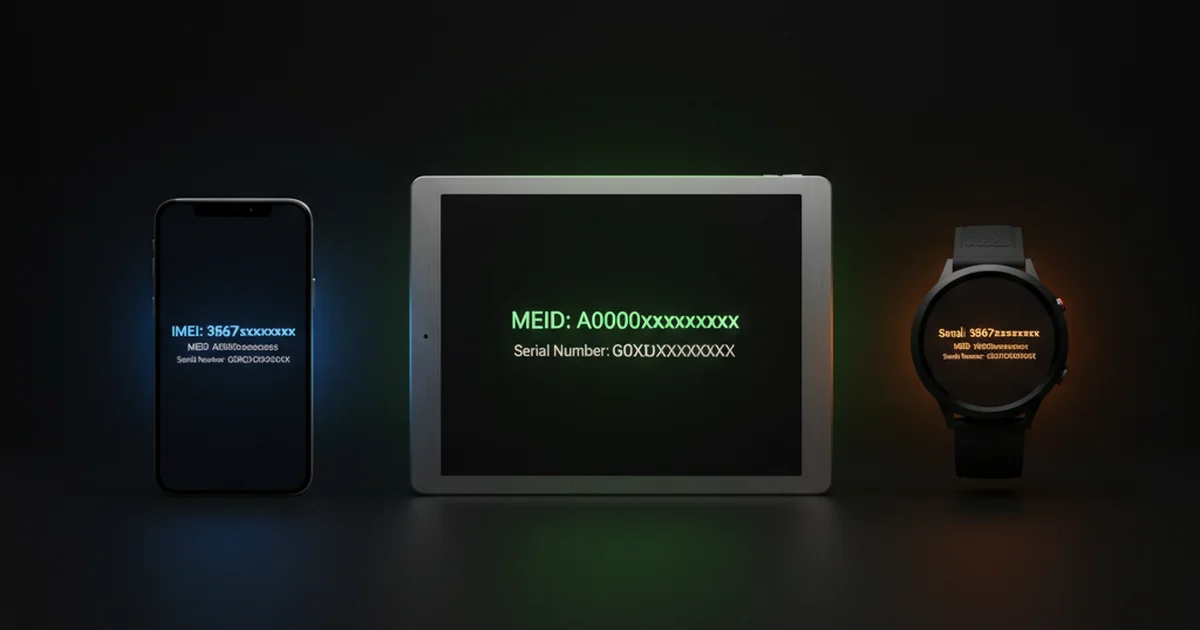
Table of Contents
- What Is an IMEI Number?
- What Is a MEID?
- What Is a Serial Number?
- IMEI vs MEID vs Serial Number — Side-by-Side Comparison
- Which Identifier Does Your Phone Use?
- How to Find Each Number on Your Device
- Which One Matters for Theft Reporting?
- Which One Matters for Warranty and Support?
- Validation: How Each Number Is Verified
- Frequently Asked Questions
What Is an IMEI Number?
The IMEI (International Mobile Equipment Identity) is a 15-digit number that uniquely identifies a mobile device on GSM, LTE, and 5G networks. It was developed by the GSMA and has been the global standard for mobile device identification since the early 1990s. Every modern smartphone sold worldwide — iPhone, Samsung, Google Pixel, OnePlus, Xiaomi — uses an IMEI.
The IMEI is a network-level identifier. When your phone connects to a mobile tower, the carrier reads the IMEI and checks it against an Equipment Identity Register (EIR). If the IMEI is blacklisted — because the device was stolen or unregistered — the carrier can deny service to the device entirely, regardless of which SIM card is in it.
The 15 digits of an IMEI break down as follows: the first 8 digits are the TAC (Type Allocation Code) which identifies the manufacturer and model; the next 6 digits are a unique serial number for that specific unit; and the final digit is a Luhn check digit used to validate the number’s integrity. See the full IMEI number structure breakdown.
What Is a MEID?
The MEID (Mobile Equipment Identifier) is a 14-character hexadecimal number used to identify devices on CDMA networks — primarily those operated by Verizon and Sprint in the United States (before Sprint merged with T-Mobile). It serves the same purpose as an IMEI, but for a different network technology.
MEID was introduced as a replacement for the older ESN (Electronic Serial Number), which ran out of available numbers due to the rapid growth of CDMA devices. Like the IMEI, an MEID is globally unique and cannot be shared between two devices. It is also used for blacklisting stolen CDMA devices, though CDMA networks themselves are being phased out globally as 5G takes over.
If you have an older Verizon or Sprint device, it likely has an MEID instead of an IMEI. Modern phones — even those sold by Verizon — now use IMEI since they run on LTE and 5G networks that require it.
What Is a Serial Number?
A Serial Number is a manufacturer-assigned identifier that is unique to each individual device unit. Unlike IMEI and MEID, which are network-level identifiers governed by international standards, the serial number is entirely controlled by the manufacturer and follows no universal format.
Apple serial numbers are alphanumeric and typically 12 characters long. Samsung serial numbers vary by model and region. Google uses a different format for Pixel devices. There is no global database of serial numbers the way there is for IMEI numbers.
Serial numbers are used primarily for: warranty claims and support tickets, device registration with the manufacturer, identifying specific units in quality control recalls, and software activation in some ecosystems. Carriers and governments do not use serial numbers for network blocking or theft reporting — that is exclusively the IMEI’s job.
IMEI vs MEID vs Serial Number — Side-by-Side Comparison
| Feature | IMEI | MEID | Serial Number |
|---|---|---|---|
| Length / Format | 15 digits (numeric) | 14 characters (hex) | Varies by manufacturer |
| Network technology | GSM, LTE, 5G | CDMA | N/A (not network-specific) |
| Governed by | GSMA (international) | 3GPP2 / TIA | Individual manufacturer |
| Used for blacklisting? | Yes | Yes (CDMA only) | No |
| Used for warranty? | Sometimes | Sometimes | Yes — primary use |
| Globally unique? | Yes | Yes | Yes (within manufacturer) |
| Validation method | Luhn algorithm | Checksum | None (varies) |
| Found in settings? | Yes | Yes | Yes |
Which Identifier Does Your Phone Use?
Almost certainly IMEI — unless your phone is a very old CDMA-only device.
Every phone sold in 2020 or later uses IMEI. The shift happened because LTE (4G) and 5G networks are GSM-based and require IMEI by design. Even Verizon, which was the last major US carrier to use CDMA for its core network, completed its transition to LTE-only operations in 2022. If you bought your phone new within the last five years, it has an IMEI — not an MEID.
Dual-SIM phones have two IMEIs: IMEI1 for the first SIM slot and IMEI2 for the second. Both are registered to the same physical device. eSIM-capable phones also have an additional EID (embedded SIM identifier), which is separate from both IMEIs.
How to Find Each Number on Your Device
Finding Your IMEI
- Dial *#06# — appears on screen immediately on any phone
- Settings > About Phone > IMEI (Android)
- Settings > General > About > IMEI (iPhone)
- On the SIM tray (iPhones) or original box sticker
- Via your Apple ID or Google account (useful if device is lost)
Finding Your MEID
- Settings > About Phone > MEID (older Android CDMA devices)
- On the device’s back label or battery compartment
- On the original box
Finding Your Serial Number
- Settings > About Phone > Serial Number
- Settings > General > About > Serial Number (iPhone)
- On the original retail box barcode label
- Apple: via appleid.apple.com under your device list
Which One Matters for Theft Reporting?
IMEI — every time, with no exceptions for modern phones. When you report your phone stolen to your carrier, the police, or a national registry like India’s CEIR or the UK’s NMPR, they will ask for your IMEI number. The serial number is not used for this purpose. The MEID is used only for older CDMA devices on Verizon or Sprint, which are increasingly rare.
This is why it is critical to write down your IMEI before your phone is stolen. After the fact, you may be able to retrieve it from your carrier account, your Apple ID, or your Google account — but having it stored somewhere safe makes the process much faster. Full guide: How to find your IMEI on any device.
Which One Matters for Warranty and Support?
Serial Number — primarily. When you contact Apple Support, Samsung Support, or any manufacturer’s customer service, they will ask for your serial number to look up your warranty status and device history. The IMEI may also be requested as a secondary identifier, but the serial number is the main one manufacturers use internally.
For carrier-related support — unlocking a device, checking blacklist status, transferring service — your IMEI is what the carrier uses. Knowing both numbers and where to find them puts you in the best position for any situation that arises.
Validation: How Each Number Is Verified
The IMEI uses the Luhn algorithm — a mathematical formula that validates the 15-digit sequence. The final digit (the check digit) is calculated from the preceding 14 digits using a specific doubling and summing process. Any IMEI that fails the Luhn check is invalid, which helps detect fakes and typos quickly.
The MEID uses a similar checksum approach adapted for hexadecimal values. Serial numbers have no universal validation standard — each manufacturer defines their own format and verification method, if any.
If you want to validate an IMEI yourself, you can use any free IMEI checker — most will run the Luhn check automatically and flag the number as valid or invalid before querying the blacklist database. Check your IMEI online using official tools.
What is the difference between IMEI and serial number?
The IMEI is a network-level identifier used by carriers and governments to authenticate devices and enforce blacklists. The serial number is a manufacturer-assigned identifier used primarily for warranty claims and support. For theft reporting and carrier blocking, only the IMEI is relevant.
Does every phone have an IMEI?
Every phone that connects to a GSM, LTE, or 5G network has an IMEI. Very old CDMA-only devices (mostly pre-2015) used MEID instead. All modern smartphones sold from 2020 onwards use IMEI regardless of carrier.
Can I find my IMEI without my phone?
Yes. If you registered your iPhone with Apple, log into appleid.apple.com to see the IMEI of all registered devices. For Android, log into your Google account and check the device list. Your carrier can also look up your IMEI from your account records.
Is MEID still used in 2026?
MEID is largely obsolete in 2026. CDMA networks have been shut down by most major carriers, including Verizon which completed its CDMA shutdown in 2022. Modern phones use IMEI exclusively, even on networks that previously used MEID.
Which number should I give the police when reporting a stolen phone?
Give them your IMEI number. Police and carriers use IMEI to file blacklist requests with national registries and the GSMA’s international database. The serial number is not used for this purpose.