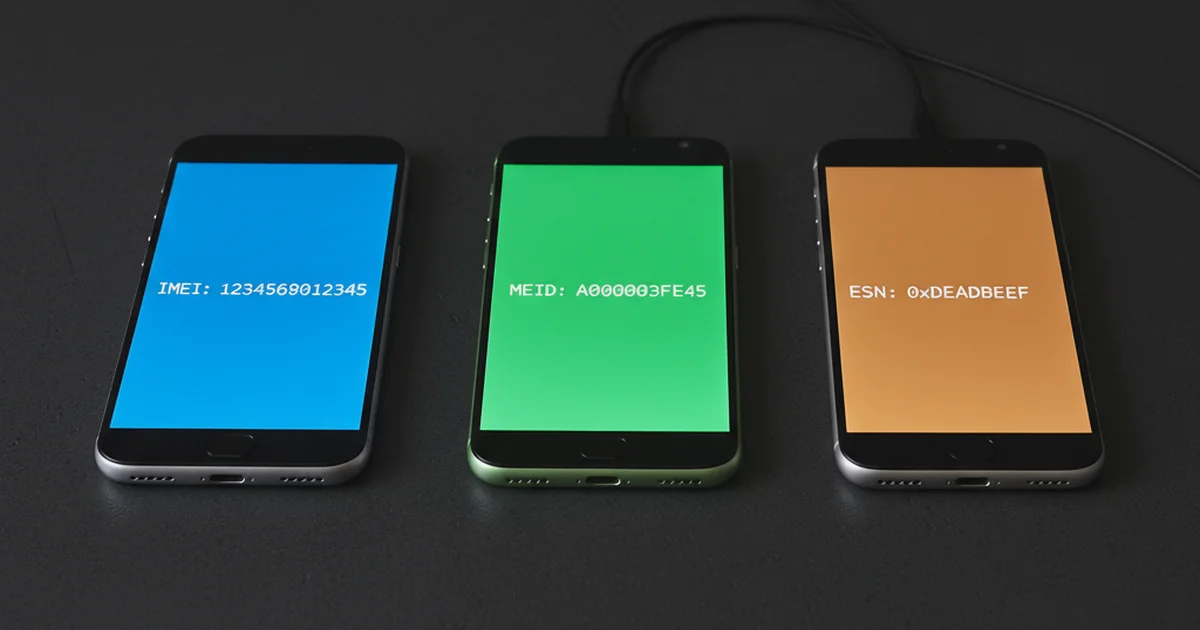

IMEI, MEID, ESN — what’s the difference? If you’ve ever looked up your phone’s technical specifications or seen these terms on an invoice, you might have wondered what they mean and which one your device actually uses. These three acronyms represent different device identification systems used by mobile networks worldwide, and understanding them is essential if you need to find your phone’s IMEI, track a stolen device, or verify a second-hand phone before purchase.

In this guide, we’ll break down what IMEI, MEID, and ESN are, how they differ, when each is used, and which identification system your phone relies on.
Table of Contents
- What Is IMEI?
- What Is MEID?
- What Is ESN?
- IMEI vs MEID: Side-by-Side Comparison
- IMEI vs ESN: Historical and Technical Differences
- Which Identification System Does Your Phone Use?
- Why Do These Differences Matter?
- Frequently Asked Questions
What Is IMEI?
IMEI stands for International Mobile Equipment Identity. It’s a 15-digit unique identifier assigned to every GSM (2G/3G/4G/5G) and LTE-enabled mobile device at the factory. This number is stored in the device’s baseband processor and transmitted to the carrier every time your phone connects to a cell tower.
The IMEI structure breaks down as follows:
- First 8 digits (TAC): Type Allocation Code — identifies the manufacturer and model
- Digits 9-14 (Serial Number): A unique serial number for that specific unit
- Digit 15 (Check Digit): A verification digit calculated using the Luhn algorithm
For a deeper dive into IMEI structure, see our dedicated guide on IMEI number structure explained.
The IMEI is the most widely used device identifier globally and is supported by every major carrier.
What Is MEID?
MEID stands for Mobile Equipment Identifier. It’s a 56-bit identifier (represented as a 14-digit hexadecimal string, or 14 decimal digits) used primarily by CDMA and 3G devices, particularly in North America. MEID was designed as an upgrade to ESN, offering more unique device identifiers than its predecessor.
The MEID structure contains:
- First 8 digits (RFX): Regional Manufacturer Code — identifies the manufacturer
- Last 6 digits (Serial): A unique serial number for that device
Unlike IMEI, which is globally standardized, MEID was region-specific to the Americas and was phased out as carriers transitioned to 4G/LTE networks.
What Is ESN?
ESN stands for Electronic Serial Number. It’s a 32-bit identifier (represented as an 8-digit hexadecimal or 11-digit decimal number) used in older CDMA networks — primarily 2G devices from the 1990s and early 2000s. ESN was the original device identifier before MEID was introduced.
Key facts about ESN:
- Limited uniqueness: ESN space was much smaller than IMEI or MEID, leading to potential collisions and reuse
- Regional use: Primarily used in North America (USA, Canada) on Verizon, Sprint, and other CDMA carriers
- Obsolete: ESN is largely obsolete today; most devices transitioned to IMEI as carriers upgraded to LTE/5G
IMEI vs MEID: Side-by-Side Comparison
Here’s how IMEI and MEID compare across key dimensions:
| Feature | IMEI | MEID |
|---|---|---|
| Full Name | International Mobile Equipment Identity | Mobile Equipment Identifier |
| Length | 15 digits (decimal) | 14 digits (decimal) or hexadecimal |
| Network Type | GSM, LTE, 4G, 5G | CDMA, 3G (legacy) |
| Geographic Scope | Global / International | Primarily North America |
| Standard Body | GSMA / ITU | 3GPP2 (CDMA standards) |
| Current Use | Universal; used on all modern phones | Deprecated; phased out by 2022 |
| Uniqueness | Globally unique per device | Unique within CDMA networks |
IMEI vs ESN: Historical and Technical Differences
ESN is essentially the grandfather of modern device identification. Here’s how it compares to IMEI:
- Age: ESN was introduced in 1989 for analog CDMA phones; IMEI followed in 1993 for GSM networks
- Capacity: ESN’s 32-bit space allowed only ~4 billion unique combinations. By the early 2000s, this was exhausted, leading to the creation of MEID
- Global adoption: IMEI became the worldwide standard; ESN remained regional
- Modern relevance: ESN is obsolete on any device manufactured after 2010. If you have an IMEI, you don’t have an ESN
Which Identification System Does Your Phone Use?
Here’s a simple breakdown:
Modern Phones (2010 onwards) — IMEI Only
If you own any iPhone, Samsung Galaxy, Google Pixel, OnePlus, Xiaomi, or any modern Android/iOS device, you have an IMEI and only an IMEI. This applies regardless of your carrier — whether you’re on Verizon (formerly CDMA), AT&T, T-Mobile, or any international carrier.
To find your IMEI on a modern phone:
- Dial: *#06# on any phone (works on iPhone and Android)
- Settings (iPhone): Settings > General > About > IMEI
- Settings (Android): Settings > About Phone > Status > IMEI (or IMEI1/IMEI2 for dual SIM)
- Physical: Check the SIM tray or device packaging
Learn more about how to find your IMEI on any device in our dedicated guide.
Legacy CDMA Phones (2000–2010) — MEID or ESN
If you own an old Verizon or Sprint phone from the 2000s, it may have an ESN (earlier models) or MEID (later 3G models). These devices are no longer in active use on major carrier networks, as CDMA was officially decommissioned in the USA by 2022.
Why Do These Differences Matter?
Understanding IMEI, MEID, and ESN matters for several practical reasons:
- Buying a used phone: When buying a second-hand device, always verify its IMEI (not MEID or ESN, which are obsolete). Check the IMEI before buying a used phone to ensure it’s not blacklisted.
- Carrier activation: Modern carriers use IMEI for device identification and activation. If you switch devices, you’ll need to provide your IMEI to your carrier.
- Theft protection: IMEI blacklisting is how carriers block stolen devices. Understanding your device’s IMEI is crucial if your phone is stolen.
- International travel: Customs and border control use IMEI registers to track smuggled devices. Your IMEI is your device’s “passport.”
- Law enforcement: Understanding device identifiers helps you comprehend IMEI security and privacy concerns, especially regarding tracking and government oversight.
Why Trust This Guide
TrackMobileIMEI specialises in device identification, IMEI systems, and mobile security. Our content is researched using GSMA specifications, ITU standards, and official carrier documentation from major network providers worldwide. We cite standardised technical documentation and avoid speculation or sales pitches.
Frequently Asked Questions
Q: Do all phones have an IMEI?
A: All mobile phones manufactured after 2010 have an IMEI. Older CDMA phones (pre-2010) may have MEID or ESN instead. WiFi-only devices like iPads do not have an IMEI unless they also have cellular capability.
Q: Can I change my phone’s IMEI?
A: Changing your IMEI is illegal in most countries, including the USA, UK, India, and Australia. It is considered device fraud. Modern phones also have hardware-level protections that prevent IMEI modification.
Q: Is MEID still used?
A: MEID was phased out as carriers transitioned to LTE. Verizon, the last major CDMA carrier in the USA, decommissioned CDMA in December 2022. If you own a modern phone, it does not use MEID.
Q: What’s the difference between IMEI1 and IMEI2?
A: Dual SIM phones have two separate IMEIs — one per SIM slot. IMEI1 corresponds to the primary SIM, IMEI2 to the secondary SIM. Both are unique and can be independently blacklisted.
Q: Can I find my IMEI without turning on my phone?
A: Yes. Check the phone’s original packaging, the SIM tray, or the back of the device (if it has a removable battery cover). The IMEI is often printed there. Alternatively, contact your carrier with your phone number — they can look up your IMEI on their system.
Q: How are IMEI, MEID, and ESN different from a phone’s serial number?
A: IMEI, MEID, and ESN are device identifiers that identify your phone to networks. Your phone’s serial number is a separate manufacturer identifier used for warranty and support purposes. They are not the same thing.