
Three identifiers — IMEI, MEID, and ESN — all designed to uniquely identify a mobile device, but each tied to a different generation of network technology. If you have an older Verizon or Sprint device, understanding the difference matters. If you have a modern phone, you almost certainly have an IMEI. This guide explains all three clearly, with a complete comparison.
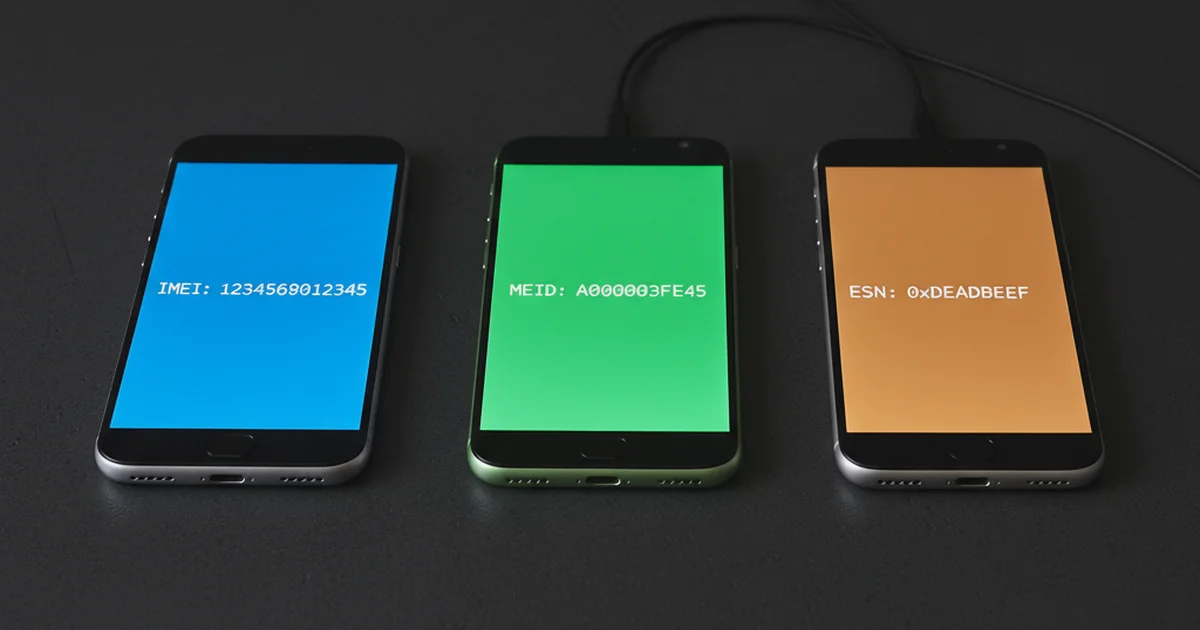
Table of Contents
- What Is an IMEI?
- What Is a MEID?
- What Is an ESN?
- Full Side-by-Side Comparison
- Which Network Technology Uses Which Identifier?
- Why ESN and MEID Are Being Phased Out
- Which Identifier Does Your Phone Use?
- How to Find Your Device Identifier
- Frequently Asked Questions
What Is an IMEI?
The IMEI (International Mobile Equipment Identity) is a 15-digit numeric identifier assigned to every GSM, LTE, and 5G mobile device. Governed by the GSMA, it has been the global standard since the early 1990s. Every modern smartphone uses IMEI — iPhones, Samsung Galaxy, Google Pixel, Xiaomi, and all other brands sold today.
The IMEI structure: 8-digit TAC (manufacturer + model), 6-digit serial number, and 1 Luhn check digit. It is validated using the Luhn algorithm, which allows instant integrity checking without a database query. Carriers use the IMEI to authenticate devices on their networks and enforce blacklists for stolen or unregistered phones. Read the full IMEI structure breakdown.
What Is a MEID?
The MEID (Mobile Equipment Identifier) is a 14-character hexadecimal identifier used on CDMA networks — primarily Verizon and Sprint in the United States. It replaced the older ESN (see below) in 2006 when the ESN address space was exhausted by the rapid growth of CDMA devices.
MEID serves the same fundamental purpose as IMEI — uniquely identifying a device on a cellular network. But because CDMA and GSM/LTE networks use completely separate authentication protocols, the two identifiers are incompatible. A CDMA carrier cannot use an IMEI in its authentication system, and a GSM carrier cannot use a MEID.
MEID is 14 hexadecimal characters (56 bits), compared to IMEI’s 15 decimal digits. The structure: 8-character manufacturer code (Regional Code + Manufacturer Code), 6-character serial number, and no check digit in the base format (though a derived decimal IMEI with a check digit can be calculated from it).
What Is an ESN?
The ESN (Electronic Serial Number) was the original mobile device identifier used on CDMA networks, introduced by the FCC in 1987. It is a 32-bit number, typically displayed as 11 decimal digits or 8 hexadecimal characters.
ESN was retired in 2006 because the 32-bit address space (~4.3 billion unique numbers) was running out due to the proliferation of CDMA devices. MEID was introduced as its replacement, offering a vastly larger address space (56 bits = over 72 quadrillion unique identifiers). Since 2006, no new devices have been assigned ESNs, and the format is now considered fully obsolete.
Full Side-by-Side Comparison
| Feature | IMEI | MEID | ESN |
|---|---|---|---|
| Length / Format | 15 digits (decimal) | 14 chars (hexadecimal) | 11 digits or 8 hex chars |
| Network type | GSM, LTE, 5G | CDMA | CDMA (legacy) |
| Introduced | Early 1990s | 2006 | 1987 |
| Still in use? | Yes — universal | Mostly obsolete (2026) | No — retired 2006 |
| Governed by | GSMA | 3GPP2 / TIA | FCC / TIA |
| Validation | Luhn algorithm | Checksum | None standard |
| Blacklisting | Yes — global GSMA EIR | Yes — CDMA carrier lists | Yes — legacy CDMA lists |
| Address space | 10^14 unique numbers | 2^56 unique values | 2^32 (~4.3 billion) |
Which Network Technology Uses Which Identifier?
| Network | Identifier Used | Status in 2026 |
|---|---|---|
| GSM (2G) | IMEI | Still active in many countries |
| UMTS / HSPA (3G GSM) | IMEI | Being shut down in most markets |
| CDMA2000 (3G CDMA) | MEID (replaced ESN) | Shutdown in USA (Verizon 2022) |
| LTE (4G) | IMEI | Active everywhere |
| 5G NR | IMEI | Active and expanding |
Why ESN and MEID Are Being Phased Out
CDMA networks — the only networks that used ESN and MEID — have been systematically shut down. Sprint merged with T-Mobile in 2020 and began migrating customers to GSM/LTE infrastructure. Verizon shut down its CDMA network on December 31, 2022. With no active CDMA networks remaining in the USA, MEID and ESN have no practical use for new devices.
Internationally, CDMA was always a minority technology — most of the world (Europe, Asia, Africa, Latin America) used GSM exclusively, meaning IMEI has been the only relevant identifier in those regions for decades. The global consolidation around LTE and 5G has fully cemented IMEI as the universal standard.
Which Identifier Does Your Phone Use?
If you bought your phone after 2020, it uses IMEI. If you have an older Verizon or Sprint device from before 2015, it may have a MEID. If you have a device from before 2006, it may have an ESN — though such devices cannot connect to any active network in 2026.
The quickest way to check: dial *#06#. If you see a 15-digit number, it is an IMEI. If you see a 14-character hexadecimal value, it is a MEID. In your settings under About Phone, you may see both listed if your device supports both identification systems — this was common on late-era CDMA phones sold in the USA that also supported LTE.
How to Find Your Device Identifier
- Dial *#06# — shows IMEI (and MEID if applicable) on any phone
- Android: Settings › About Phone › IMEI / MEID Information
- iPhone: Settings › General › About › IMEI
- Original box: barcode sticker lists IMEI, and MEID if present
Full guide: how to find your IMEI on any device.
What is the difference between IMEI, MEID, and ESN?
IMEI is a 15-digit identifier used on all modern GSM, LTE, and 5G networks. MEID is a 14-character hexadecimal identifier used on CDMA networks (now largely obsolete). ESN is an older 32-bit CDMA identifier retired in 2006. All three uniquely identify a mobile device, but they are incompatible with each other and each designed for a different network technology.
Does my phone have an IMEI or MEID?
If you bought your phone after 2020, it has an IMEI. Dial *#06# to check — a 15-digit number is an IMEI, a 14-character hexadecimal value is a MEID. Modern phones sold by all carriers, including Verizon, use IMEI since they run on LTE and 5G networks.
Are MEID and ESN still used in 2026?
No. Verizon shut down its CDMA network in December 2022, which was the last major active CDMA network in the USA. MEID and ESN have no practical use for new devices. All active networks in 2026 use IMEI.
Can I convert a MEID to an IMEI?
A pseudo-IMEI can be mathematically derived from a MEID by converting it to decimal and appending a Luhn check digit. This was used during the transition period when CDMA devices also needed to register on LTE networks. However, this is a legacy compatibility measure and not relevant for modern devices.
Which identifier is used for blacklisting stolen phones?
Modern phones use IMEI for blacklisting. When you report a stolen phone to your carrier or a national registry like CEIR (India) or the GSMA’s international database, they blacklist the IMEI. MEID was used for blacklisting on CDMA networks, but those networks are now offline.
Comment (1) on "IMEI vs MEID vs ESN: Key Differences & Which Your Phone Uses (2026)"
Comments are closed.